



Burma Spores
Price range: $9.94 through $106.50
Burma is a vigorous Psilocybe cubensis strain reportedly collected in Southeast Asia and introduced to Western mycology by ethnomycologist John Allen. Known for aggressive colonization and thick-walled spores, it offers researchers a robust specimen for both microscopy and culture studies.
Description
Collected in Southeast Asia
The Burma strain entered the Western mycological scene through John W. Allen, an ethnomycologist who spent years documenting psychoactive fungi across Southeast Asia during the 1990s. Allen reportedly received a specimen collected near rice paddies in Burma (now Myanmar), where Psilocybe cubensis thrives in the monsoon climate on water buffalo dung. The isolate proved exceptionally vigorous in culture and quickly gained popularity among researchers.
Microscopic Profile
Burma spores are subellipsoid with dimensions in the range of 12 - 16 × 8 - 11 micrometers. Their pigmentation sits at the darker end of the cubensis spectrum, a deep purplish-brown to nearly black in dense print regions. Wall thickness appears slightly above average for the species, which contributes to excellent structural integrity on microscopy slides. The germ pore is prominent and clearly delineated, making these spores particularly photogenic at high magnification.
Physical Characteristics
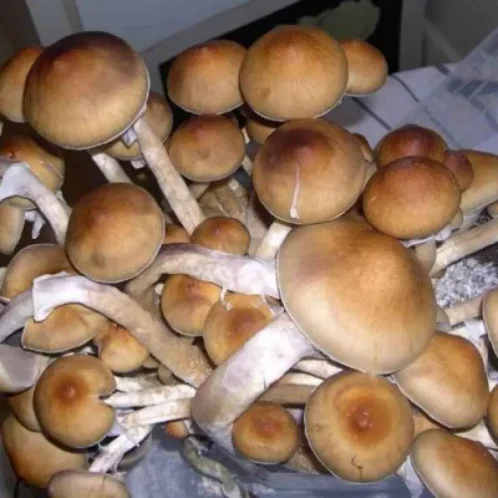
Fruiting bodies of the Burma lineage tend toward broad, fleshy caps that expand quickly from convex to plane. Cap coloration is typically a light golden-brown that can appear almost white at the margins in well-hydrated specimens. Stipes are thick, meaty, and relatively short compared to cap diameter, giving the overall mushroom a stocky profile. Bruising reaction is pronounced, even gentle handling produces vivid blue-green discoloration. The partial veil usually tears cleanly, leaving a thin but persistent annulus.
Significance for Researchers
Burma’s reputation for rapid mycelial expansion in culture makes it useful for studies examining colonization kinetics and competitive interactions with contaminant organisms. In a comparative microscopy context, its slightly larger-than-average spores and dense prints pair well against finer-spored strains like PES Hawaiian when teaching students to recognize size variation within Psilocybe cubensis. Preferred substrate temperatures run 27 - 29°C for colonization and 23 - 26°C for fruiting.
Offered exclusively for microscopy research, taxonomic study, and educational purposes. Always check local regulations before purchasing.
Additional information
| Weight | 1 lbs |
|---|---|
| CHOOSE TYPE | SINGLE SYRINGE, TWO SPORE SYRINGES, FOUR SPORE SYRINGES, 10-PACK SYRINGES, SPORE PRINT |
| CHOOSE CONCENTRATION | NORMAL CONCENTRATION, SUPERCHARGED SPORES |
You may also like…
-

Mushroom Grow Jars
Price range: $10.46 through $77.39 Select options This product has multiple variants. The options may be chosen on the product page
Related products
-
 Sale!
Sale!

Jamaica Spores
Price range: $19.98 through $217.50 Select options This product has multiple variants. The options may be chosen on the product page -

Thai-Tanic (Thai Lipa Yai Cubensis) Spores
Price range: $9.94 through $106.50 Select options This product has multiple variants. The options may be chosen on the product page -


PES Amazonian Spores
Price range: $9.94 through $106.50 Select options This product has multiple variants. The options may be chosen on the product page -


B+ Spores (B Plus Spores)
Price range: $9.94 through $106.50 Select options This product has multiple variants. The options may be chosen on the product page
